
15 April 2026 · 6 min read
How to turn a photo into a coloring page: what works and what fails
Not every photo makes a good coloring page. Framing, light, contrast: those are the criteria that separate a page you love coloring from a blurry mess that puts you off.
Turning a photo into a coloring page happens in two steps. First, extract the outlines of the image. Then simplify those outlines so you get a drawing you can color without getting lost. The first step is mechanical. The second is where most consumer tools fall over.
Curious how your own photos would turn out?
Pick a format, upload your photos, and we take care of the rest.
See formats and pricesPhotos that make a good coloring page
Four criteria account for 90% of the result: a sharp face, light that creates contrast without flattening, a subject that takes up at least a third of the image, and a background that isn't too busy. A portrait taken outdoors in late afternoon usually ticks all four boxes. The lowest-risk way to find out is still to see the result on your own photos with the digital version rather than judging from cherry-picked examples.
- Sharp face: any blur produces hesitant outlines and a messy drawing.
- Moderate contrast. A backlit face yields almost no usable lines.
- Medium to tight framing: group shots taken from too far end up as tiny silhouettes.
- Simple background: a wall, the sky, foliage. Not a packed market scene.
Photos that almost always fail
Short-arm selfies with wide-angle distortion, sleeping babies whose face disappears under the blanket, class photos taken from a distance, indoor flash shots: in all those cases, the outline extraction produces either too few lines (the face fades out) or too many lines (impossible to color).
Simplification, the step that changes everything
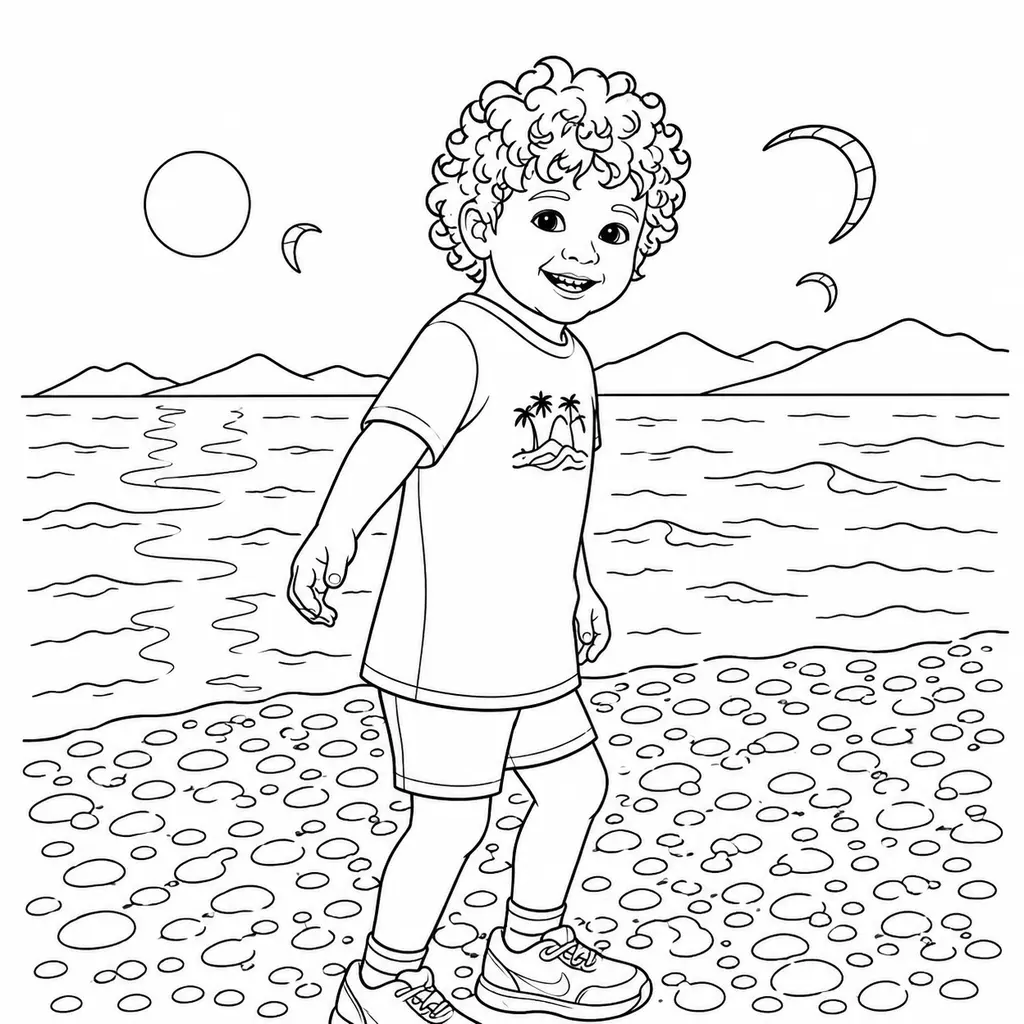
Once the outlines are extracted, there's real work left. Strip the unnecessary details: fine wrinkles, t-shirt folds, foliage shadows. Thicken the structural lines: face, eyes, hair. Close the regions so they can be filled in with markers. That step, whether done by hand by an illustrator or by a properly trained AI model, is what separates a satisfying coloring page from a tangle of lines.
The role of paper in the final result
A beautiful drawing on bad paper makes a bad coloring page. On really thin paper (70 to 80 gsm), markers bleed and punch through, and you give up after two pages. We print our albums on 90 gsm uncoated paper. That isn't the weight of premium coloring books, which sit closer to 120 or 160 gsm. But it's the heaviest uncoated stock our print-on-demand partner offers, and it handles colored pencils, pastels and water-based markers well. Alcohol markers like Sharpies will bleed through: keep a backing sheet handy.
A successful coloring page rests as much on the drawing's simplification as on the paper that receives it.
How long for a full album
For a personalised album of 6 to 24 photos, count on 1 business day of processing (extraction, simplification, layout, review), then 6 to 9 business days of production. That's 7 to 10 business days from order to shipping, with carrier transit added on top depending on the destination. Services that promise a personalised album delivered in 24 hours are either doing raw extraction (mediocre output) or running pre-printed stock that they only personalise on the cover.
And if the printing timeline doesn't work for your occasion, the album also comes as a digital version (PDF): the same photo processing, with the download link emailed as soon as you pay, ready to print at home.
Our personalized books made from your photos
Three ways to turn your family photos into an activity book, from free coloring to guided play.
- Personalized coloring book
Each photo becomes a color keepsake page and the same scene to color freely.
- Personalized color by number
Your photos as numbered zones with a color legend: guided coloring, true to the memory.
- Personalized dot to dot
The drawing of your photo appears as you connect the numbers, then gets colored in.
Ready to turn your photos into a coloring book?
Designed in France, checked page by page before printing.
See the formats and create my bookGift ideas related to this article
Personalised Mother's Day gift
A one-of-a-kind personalised coloring book made from your family photos. A Mother's Day gift to give your mum or grandmother, to colour together.
Personalised Christmas gift for kids
Under the tree this year: a unique coloring book made from your family photos. Designed in France, delivered before Christmas.
Birthday gift for a 5-year-old
5 years old: the age where the child stays in the lines and tells stories. Personalised album designed in France.
Personalised gift for grandma
Grandma, grandpa, godfather, godmother: a gift that steps out of the photo frame. Personalised coloring book designed in France.